Risk Management on Two Wheels
Motorcycle clothing is not about finding some perfectly safe uniform. It is about understanding the risks, choosing the compromises and giving yourself a better chance of being seen.
There is a tendency to talk about motorcycle clothing as though there were one correct answer. Wear this, never wear that, fluorescent yellow is safe, black is dangerous, leather is proper motorcycle clothing and anything else is asking for trouble. I have never found that sort of absolutism particularly useful. Riding a motorcycle is not an exercise in eliminating risk. If that were the objective, the first sensible precaution would be not to get on one. It is an exercise in managing risk.
I have just had an HMS Conway Motorcycle Club hoodie made. It is black, because black suits the artwork and looks right as leisure wear. I have no particular intention of riding in it. That does not mean there is anything inherently wrong with riding in a hoodie, provided suitable protection is being worn underneath. A light-coloured hoodie over proper body armour can be a perfectly sensible combination. The point is to understand what each layer is there to do.
My normal riding gear takes a rather different approach. I have gone for what might generously be described as a fetching Royal Navy white, grey and blue camouflage ensemble, together with a light-grey helmet which happens to match the Virago rather well. The gear is Kevlar-reinforced and has its own built-in armour, so it is intended to provide both abrasion and impact protection as well as clothing me.
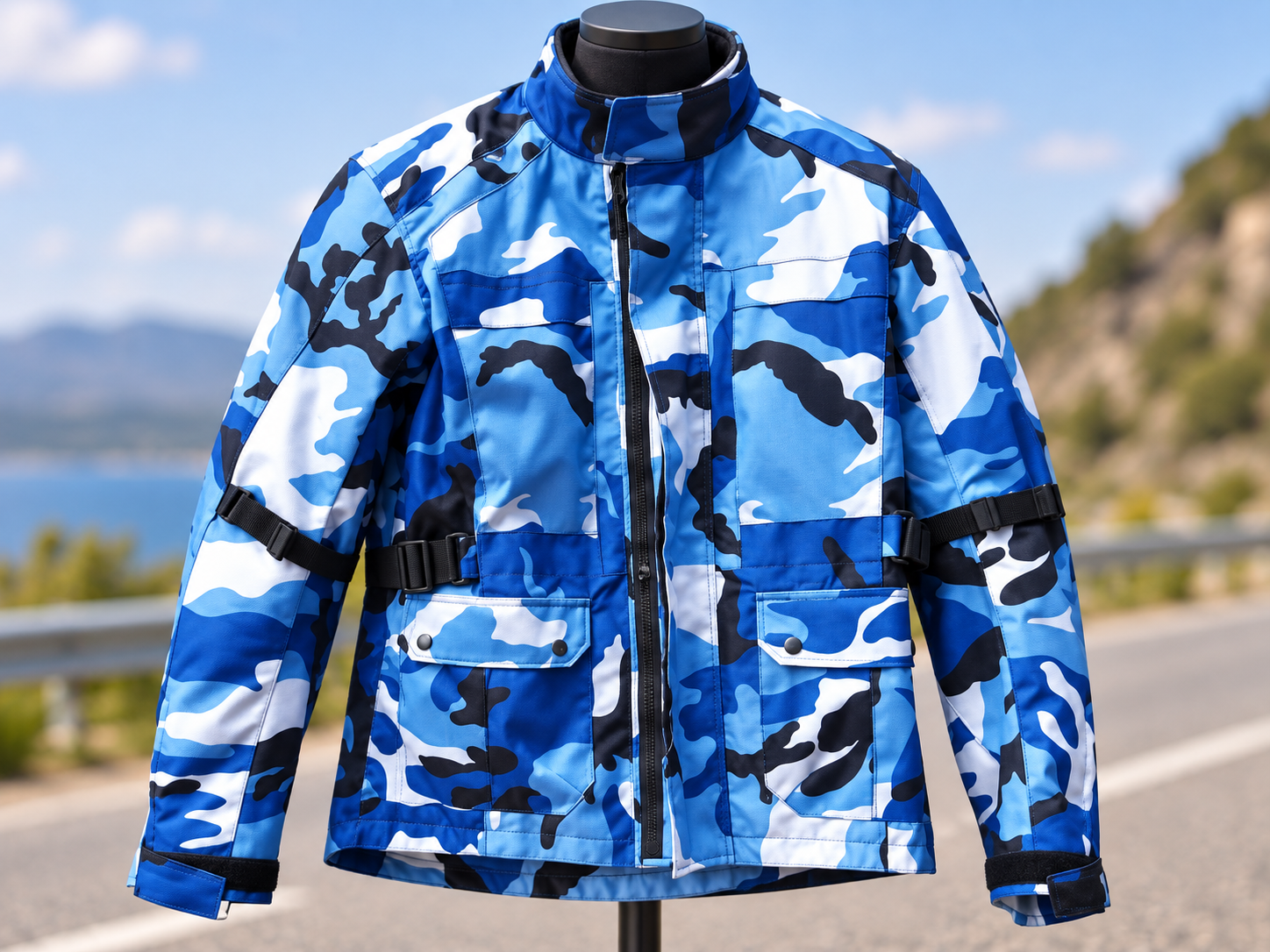
The camouflage is also rather better at being camouflage at sea than it is on the M5. Against tarmac, hedges, cars and most of the visual clutter of a British road, all that pale grey, white and blue stands out rather well. That is deliberate.
What genuinely horrifies me is the number of motorcyclists who dress almost entirely in black. The same applies to cyclists in black Lycra. On an open road in bright sunshine they may be perfectly obvious. Put them on a tree-lined road in dappled sunlight and the situation changes dramatically. A black-clad rider can disappear into the darker patches beneath the trees, then reappear as the background changes.
There is some basic visual science behind this. What matters is not simply colour, but contrast. Our eyes distinguish objects partly through differences in brightness, colour and pattern between the object and its surroundings. A black motorcycle jacket against deep shade, dark foliage and tree trunks offers relatively little luminance contrast. Add rapidly alternating patches of sunlight and shadow and the visual scene becomes harder to interpret at a glance. The rider has not literally vanished into the interstices of spacetime, of course, but he can become much less conspicuous.
Pale clothing works differently, not because grey, white and light blue are intrinsically safe colours, but because on many British roads they contrast strongly with what happens to be behind them. My light-grey helmet helps for the same reason. It sits high in the visual field and is often noticeably different from the background.
Pattern matters as well. Camouflage works by breaking up an outline when its colours resemble the surroundings. Change the surroundings and the same pattern may have precisely the opposite effect. Royal Navy camouflage may be reasonably effective against sea, sky and grey superstructure. Against a Gloucestershire hedge it is not fooling anybody.
That is why I find the almost universal preference for black motorcycle clothing slightly odd. I understand why people like it. Black looks good, hides muck and has been part of the visual language of motorcycling for generations. But if I can have protection, clothing I actually like and better contrast with my surroundings at the same time, I see no particular virtue in making myself harder to see.
Hot weather presents a different problem. Proper motorcycle clothing can become extremely uncomfortable, and equipment which is so hot that you are tempted not to wear it has introduced another risk rather than solving one. For those conditions I have a separate armour vest, including arm protection, over which I can wear a lightweight reflective zip jacket. A light-coloured hoodie could equally go over the armour when the temperature suited it.
Motorcycle clothing has several jobs. It may need to provide impact protection, abrasion resistance, warmth, rain protection and conspicuity. It also needs to be comfortable enough that you actually wear it. There is no particular reason why all of those functions must be contained within a single garment.
Nor does conspicuous clothing absolve the rider from everything else. Road position, speed, observation, lighting and anticipating what other road users might do remain fundamental. Dressing like a Belisha beacon does not prevent somebody pulling out in front of you. It simply gives them a better chance of detecting you in the first place.
My approach to the motorcycle itself follows much the same reasoning. I previously owned a Triumph Daytona 955i and came off it at a roundabout, escaping with a severely dislocated thumb and a wife who subsequently gave me a good talking to. When I returned to motorcycles at 71, I bought a Yamaha XV535 Virago partly because I like the way it looks and partly because, at around 180 kg, if I drop it I can pick it up.
I am perfectly capable of riding a much larger and more powerful motorcycle, but that is no longer the only question worth asking. I do not need another 50 horsepower merely because I am capable of controlling it. I want enough performance to enjoy myself, a motorcycle with some character, and something I can continue to manage when gravity eventually gets a vote.
The same applies to clothing. Maximum protection in every conceivable circumstance is not the only consideration, any more than maximum horsepower is. Neither is dressing entirely for appearance while ignoring what happens when things go wrong. The sensible point lies somewhere between those extremes.
So I shall continue riding a 27-year-old V-twin in conspicuous Royal Navy camouflage, with proper protection underneath or built into the clothing, a light-grey helmet and a reflective outer layer when the weather calls for it. None of that makes motorcycling safe, and I do not pretend that it does.
It simply shifts some of the odds in my favour without removing the reason I got back on a motorcycle in the first place.
That, to me, is risk management.