


Four Workshop Visits, Three Days’ Riding and a £14 Ignition Coil
Why changing a coil on a 1999 Yamaha XV535 Virago turned into the restoration of a part I hadn't intended to touch.
I have owned my 1999 Yamaha XV535 Virago for the best part of two months. In that time I have actually ridden it for about three days.
The rest of our relationship has largely consisted of me looking at it, taking it to the workshop, collecting it from the workshop, briefly believing it was fixed and then arranging to take it back to the workshop.
When I bought it, it had an intermittent misfire. My first assumption was fairly obvious. It was an old bike which had presumably spent periods standing around, so I suspected a build-up of gum in the carburettors. It went into the workshop and the carbs were rebuilt.
That was the first of four visits.
The irritating thing was that on each subsequent visit they found something genuinely wrong. There was a split fuel line. The carburettor float level was wrong and had to be reset. The float chamber was replaced, and the plugs were replaced and regapped. There was another fault along the way which, irritatingly, I can no longer remember. Each time there was a perfectly plausible explanation, something was repaired, the bike seemed to run properly and everybody thought it had been fixed.
Except me, increasingly.
The problem always came back and, more significantly, it was always the rear cylinder. The bike would start perfectly happily on both and could run normally for quite some time. Then the rear cylinder would disappear. On the motorway I had managed about 64 mph on one cylinder; at intermediate revs it would sometimes flick between one and two, and on the overrun there was a fair amount of popping and backfiring.
By then I was becoming convinced that we were looking for a fuel problem which wasn’t actually a fuel problem. There had undoubtedly been faults in the fuel system, and fixing them was worthwhile, but the fact that the same cylinder repeatedly disappeared, particularly after the bike had warmed up, kept pointing me towards the ignition. I suspected the rear ignition coil was breaking down when hot.
So the plan was to take it back to the workshop for a fifth visit, have the rear coil replaced and get them to fit the rear crash bars I’d bought at the same time.
There was also a deadline looming. The Virago has to be ready by the 16th because I want to take it to the HMS Conway AGM. After owning the thing for nearly two months and managing about three days of actual riding, arriving at the AGM on it rather than merely possessing photographs of it has become something of a point of principle.
Then I had a free day and thought: how difficult can changing an ignition coil be?
This is, of course, a question which has preceded some of mankind’s less successful enterprises.
Getting at the coils on an XV535 isn’t particularly convenient. The visible fuel tank had to come off, which immediately produced an entirely unrelated mystery. Something fairly substantial was rattling around inside it. Removing the filler cap didn’t help because the Virago has a peculiar tank arrangement. The filler neck projects a long way down into the upper tank, leaving only narrow passages around it. Whatever was inside could move about quite freely but couldn’t get back around the filler neck and escape.
A large welding magnet had no effect on it, so whatever it was probably wasn’t ferrous. The inside of the tank itself looked remarkably clean. Eventually common sense prevailed. If the object couldn’t negotiate the tank’s internal geography sufficiently well to get out through the filler, it was exceedingly unlikely to find its way into a tiny fuel outlet. It had presumably been in there for years and could remain there. There are limits to curiosity.
With the tank out of the way I eventually reached the ignition coils, hidden behind their cover at the front of the bike. That was when what should have been a simple £14 coil replacement turned into something rather more worthwhile.
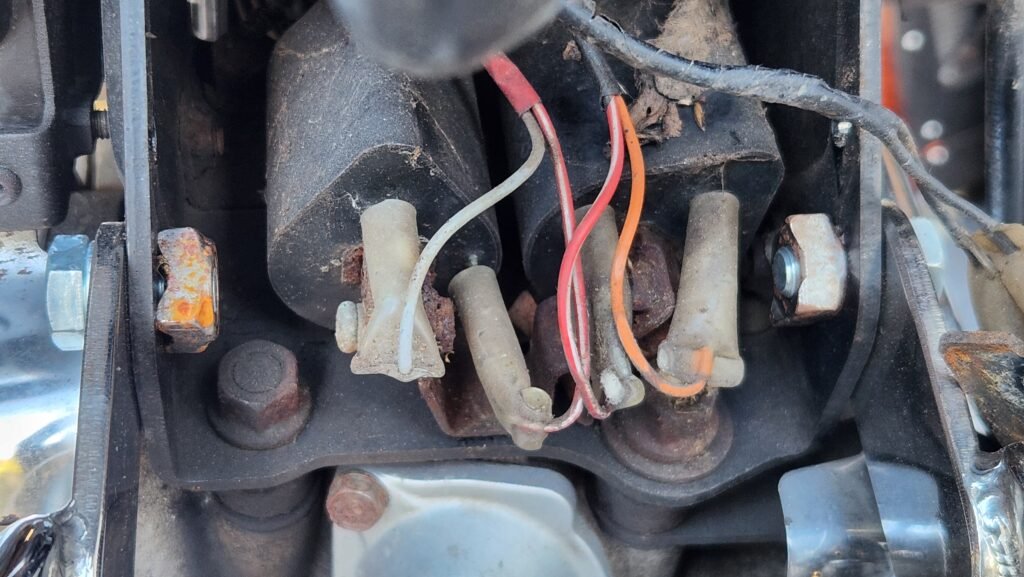
The two coils were mounted on a steel bracket which had apparently spent much of the previous 27 years quietly rusting. The corrosion around the coil cores, terminals, screws and bracket was considerable. The coils were effectively rusted into the bracket. Some of the screws weren’t remotely interested in being screws any more, and two surrendered their crossheads during the ensuing negotiations.
At this point I began to be rather pleased that I hadn’t simply taken the bike back to the workshop.
That isn’t a criticism of the workshop. Had I delivered the bike and said, “Replace the rear coil”, they would quite reasonably have replaced the rear coil. I would have been paying them to repair an ignition fault, not spend several hours restoring an obscure piece of 27-year-old pressed steel hidden behind a cover. They might have cleaned it up a little, but I very much doubt that the bracket would have received the treatment it was about to get on my bench. More likely, a new coil would have gone onto an old rusty bracket and the whole lot would have disappeared behind the cover again, storing up a rather more awkward problem for somebody in the future.
There was also a slightly perverse bit of economics involved. A replacement ignition coil costs about £14. The mounting bracket, Yamaha part 2GV-21359-00, is discontinued and I couldn’t find another one in the UK. The cheapest used example I could find was in Belgium at £12.36, accompanied by £18.68 postage. More than £31 for a second-hand bracket whose principal distinguishing feature was that it wasn’t quite as rusty as mine.
At which point preserving two 27-year-old ignition coils began to look rather silly.
It was actually cheaper to regard the old coils as expendable, save the original bracket and buy two new coils. And replacing both coils made more sense anyway. If one original coil really had started breaking down through age and heat, its equally elderly companion could hardly be regarded as a particularly secure long-term investment. For another £14 I could replace both coils and both HT leads and eliminate a substantial chunk of the ageing ignition system at once.
So the priorities reversed. The £14 electrical components became disposable and the rusty bit of pressed steel became the valuable part.
Both coils came off, although not necessarily in the manner envisaged by Yamaha. The bracket survived intact. I wire-brushed everything I could reach, but its shape meant there were areas where no sensible wire brush was going to get near the metal. So the entire bracket went into a citric-acid bath.
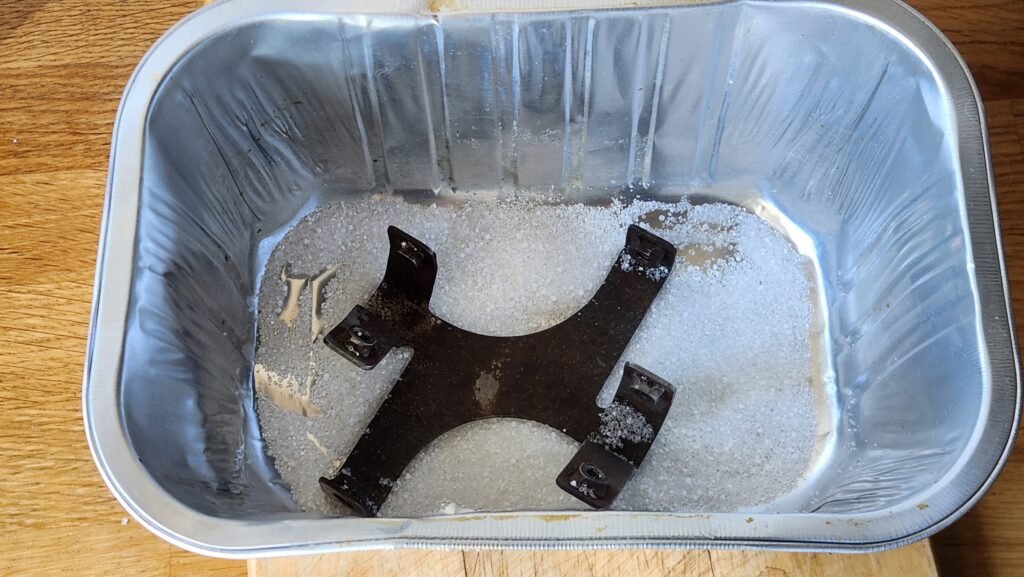
I didn’t leave it there for hours trying to produce concours bare metal. About half an hour was enough to attack the remaining rust, particularly in the inaccessible folds and around the mounting points. Once rinsed and dried, the difference was considerable. What had looked like a rather sorry and potentially disposable piece of rusty steel turned out to be perfectly sound underneath.
It then got rather more attention than Yamaha can ever have imagined anyone lavishing on an ignition-coil bracket. After the citric acid it was treated with Jenolite, then primed and finally painted in VHT silver.
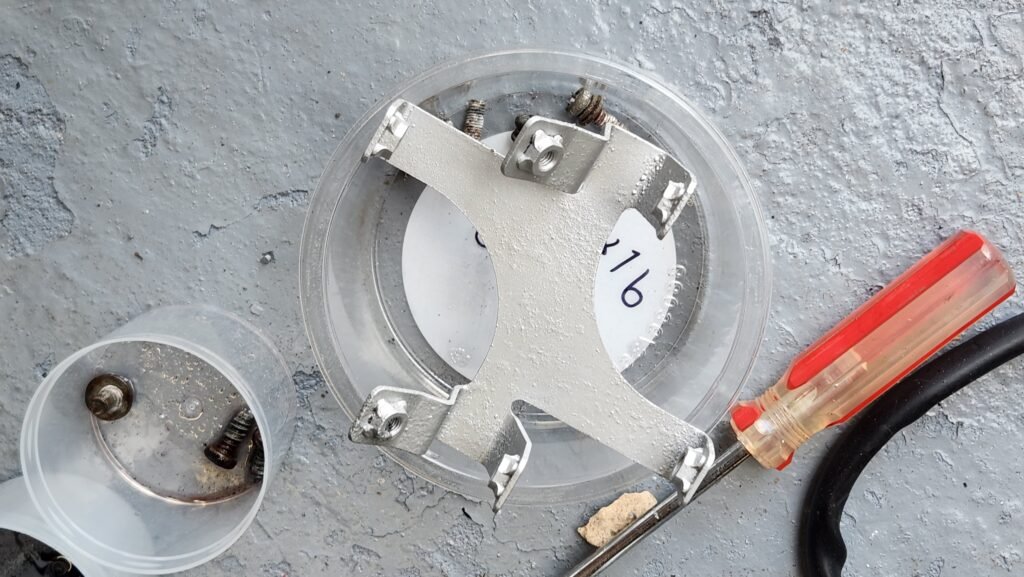
Why silver? Principally because I had some.
There was some method in it too. The bracket lives in a dark and rather inaccessible recess at the front of the bike, and the silver makes the whole assembly much easier to see if I ever have to go in there again. Given the entertainment involved this time, I rather hope I don’t.
The damaged crosshead screws were another easy decision. The originals holding the coils to the bracket are M5 x 16, so the mangled ones could simply be replaced. I saw no compelling reason to reproduce Yamaha’s original choice of crosshead screws, however. Socket-head replacements will be considerably easier to deal with if the assembly ever has to come apart again, particularly with a little anti-seize on the threads.
There is a broader lesson in this which applies to most old vehicles. A repair shop and an owner are not necessarily doing the same job.
The workshop’s objective is quite reasonably to diagnose the reported fault, replace or repair the defective component and return the vehicle. My objective, once I had the thing dismantled on my drive and could see what 27 years had done behind the cover, became slightly different. There was no sensible reason to bolt shiny new components onto a rusty bracket and conceal the whole lot again for another decade.
Nor does any of this mean the workshop was wrong about the previous faults. The carburettors needed attention. The fuel line really was split. The float really was incorrectly set. Those were genuine defects and needed fixing. But finding a fault isn’t necessarily the same thing as finding the fault, and I remained suspicious because none of them adequately explained why the same cylinder repeatedly stopped firing once the bike had been running for a while.
Whether my electrical diagnosis proves correct still has to be established when the Virago is reassembled and properly road-tested. I’m not declaring victory simply because I’ve found something rusty and bought some new parts. Old vehicles have a nasty habit of regarding premature triumphalism as a challenge.
But even if the coils turn out not to have been the cause of the misfire, I’m glad I decided not to make that fifth trip to the workshop. I went looking for a faulty ignition coil and discovered a piece of the bike that probably hadn’t seen daylight since Tony Blair’s first term in office. It has now been dismantled, derusted in citric acid, treated with Jenolite, primed and finished in VHT silver. Both 27-year-old coils are being replaced for less than the cost of importing a second-hand bracket from Belgium, and the whole assembly should now be good for rather longer than I am likely to require it.
More importantly, I have until the 16th to put it all back together, prove that it will stay resolutely on two cylinders and get it to the HMS Conway AGM under its own power.
All because I had a free day and thought I’d tackle a simple little job myself.
I really should know better by now.