Still Riding at Eighty-One
Age may change the motorcycle, but it need not end the ride.
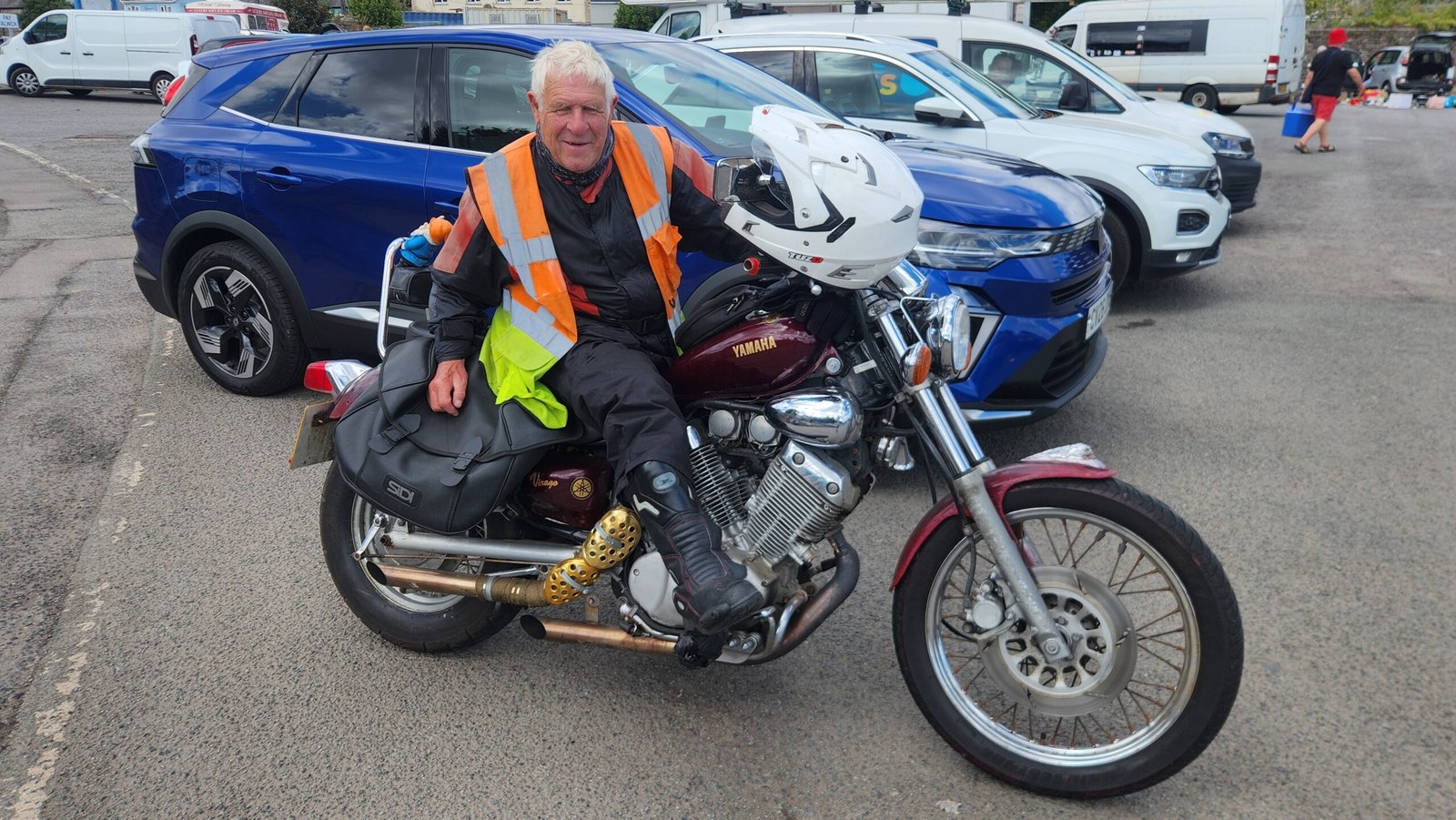
Whenever we head down to Pembrokeshire we tend to call in at Laugharne on the way. On a Wednesday there is a small market in the car park by the castle and, more importantly, a chap comes up from Cardiff who makes quite extraordinarily good jams and chutneys. I make straight for the whisky and chilli marmalade. Hay stocks up on runner bean chutney. Both are dangerously good, and probably reason enough on their own to keep visiting Laugharne.
Last time, though, something else caught my eye. Parked nearby was a rather shabby Yamaha Virago 535 and, beside it, its equally well-travelled owner. An old bloke in leathers. Being incapable of minding my own business when motorcycles are involved, I got talking to him and eventually asked his age.
Eighty-one.
And no, he had absolutely no intention of hanging up his leathers.
Good.
There seems to be a peculiar assumption that, as we get older, we should progressively give up the things that involve risk, excitement, physical effort or the slightest possibility of falling over. Motorcycles are somewhere near the top of that list. At some unspecified age we are apparently supposed to exchange the bike for sensible shoes, a National Trust membership and an increasingly close relationship with the television remote control.
I have nothing against sensible shoes or the National Trust. I object to the assumption that age should automatically determine what somebody is allowed to enjoy. Obviously age matters. Eyesight changes, reactions slow, strength diminishes and bones become less forgiving. Pretending otherwise is silly. An 81-year-old riding a motorcycle needs to make rather different judgements from an 18-year-old who believes himself immortal.
But that is the point. Judgement.
The question isn’t whether somebody is 71, 81 or 91. It is whether they are still capable of doing what they are doing safely. Older motorcyclists also have one considerable advantage over the young version of themselves: they have normally stopped trying to prove anything.
The bloke on the Virago wasn’t going to be attempting to get his knee down through the bends outside Laugharne. He wasn’t interested in impressing anybody. He was riding an old 535 Virago, for heaven’s sake. It is difficult to imagine a motorcycle less interested in encouraging hooliganism.
There is actually some evidence behind that rather obvious observation. Speed features heavily in serious motorcycle accidents, as does simply riding too fast for the conditions. Drink is involved rather less often than I had assumed, and older road users are substantially less likely to be involved in drink-driving collisions than younger ones. That does not make the older biker invulnerable. Quite the opposite. If an 81-year-old comes off, the consequences are likely to be considerably worse than for somebody of 21 because old bones do not bounce particularly well.
But risk is not just about how badly things go wrong. It is also about how likely they are to go wrong in the first place, and how much of that risk you can control. The 81-year-old on the slightly tatty Virago may be physically more vulnerable, but he is also less likely to fit the stereotype of the younger rider exploring the outer limits of the machinery, his judgement and occasionally the Highway Code.
Age takes things away from you, certainly. It can also remove quite a lot of stupidity.
And he was still riding. He still had to balance the bike, control it and read the road, and he still had the wind around him and that peculiar sense of involvement you get on two wheels that simply doesn’t exist inside a car. That matters, because we spend a great deal of time talking about extending life and perhaps rather less time thinking about what we are extending it for.
There is not much achievement in reaching 90 if the last twenty years consist entirely of being told not to do things. Of course there comes a day when every biker should stop, but the important word is “when”, not “age”. When you can no longer control the machine properly, when your reactions really are too slow, or when strength and balance have deteriorated to the point where the risk is no longer sensible, then perhaps it is time. But that decision should be based upon ability, not the number on a birthday card.
There is also an element of choosing your machinery accordingly. A Virago 535 weighs somewhere around 195 kg ready to go. A modern Triumph Rocket 3 is about 320 kg. I rather fancy a Rocket 3, but there is a difference between admiring something and deciding it is a sensible motorcycle to own when you are in your seventies.
Even picking up a fallen motorcycle is more about technique than brute strength. With the right method, a surprisingly heavy bike can be brought upright without attempting some heroic dead-lift from the tarmac. I can imagine doing that with the Virago. With 320 kg of Rocket 3 lying on its side, however, I might still be tempted to employ the other recognised technique: find another bloke.
That, to me, is sensible ageing. Not giving up the things you enjoy, but adapting them to suit the bloke doing them. Ride within your abilities, accept that gravity is becoming less negotiable, and perhaps don’t buy a motorcycle that requires a small crane every time you misjudge a camber in a car park.
For a club such as HMSCMC, populated by people for whom advancing age is hardly an abstract future possibility, that seems quite a useful principle. Whether the interest is motorcycles, classic cars or anything else with an engine attached, growing older need not mean losing interest. It may simply mean choosing the machinery rather more carefully.
Perhaps in another ten years I shall find myself somewhere in Wales, sitting on an increasingly shabby Virago while some interfering youngster asks how old I am. If the answer is 81, I hope I give him exactly the same answer.
No intention of hanging up the leathers just yet.